

Whew, chile.
Like the rest of you, I watched the ANTM documentary. And listen — for all the show’s flaws (and yes, there were many), it did do some good. At least for me. It gave me a glimpse into the cutthroat fashion world I so desperately wanted to be part of growing up — a Black, gay, flamboyant, artsy boy in Durham, North Carolina, dreaming of New York City.
I can’t imagine my life without America’s Next Top Model. Honestly, I don’t know if I would have made it out of Durham and into the NYC fashion industry — as a model and later as a designer — without it. The hindsight critiques of the show are fair, but what often gets lost is this: for the first time, little gay boys everywhere saw someone who looked and loved like us being celebrated on television.
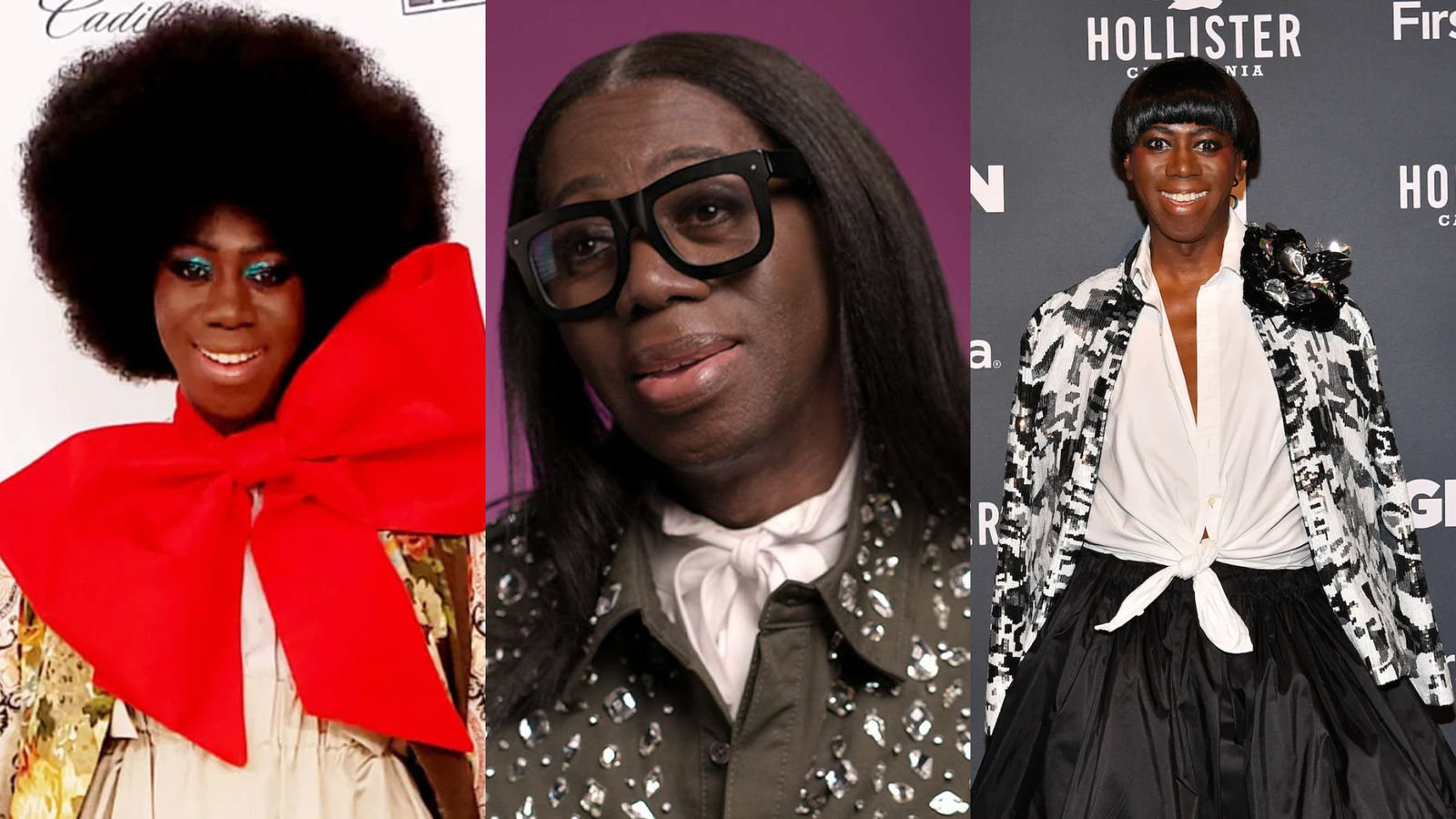
I saw Miss J Alexander.
And suddenly, I knew I could make it.
Seeing the Jays on TV made it okay for me to be out loud and proud in a small Southern town. It even gave people around me a point of reference. Instead of being called a slur, people would say, “Oh, you remind me of Miss J.” And I took that as a compliment — because it meant they understood I was fabulous, and maybe someone like me could be on TV one day too.
Representation works like that. Sometimes it doesn’t erase cruelty, but it shifts the conversation. It makes space where there wasn’t any before.
As fate would have it, I actually met Miss J at a NYC Pride event in 2019. I spotted him across a rooftop and marched right over, determined to say hello and get a photo. I assumed the interaction would be quick, but he stayed and talked with me. I thanked him over and over, explaining how much it meant to see someone like him — someone like me — represented with confidence and joy on television. I asked if he realized the impact he had on so many Black gay boys watching from places like Durham.
He humbly replied, “Oh honey, I didn’t even think of it that way. I was just doing my job.”
But that’s the thing about representation: sometimes the people creating it don’t realize how life-changing it is for those watching.
I came to ANTM a little late. I grew up in an extremely religious household, so “secular” TV wasn’t really allowed. I missed the early seasons (along with many other pivotal millennial pop culture moments). But by tenth grade, I was spending weekends at my best friend Syd’s house, catching up on all that I had missed. One day, after learning I wanted to be a model and designer in New York, she insisted we watch a marathon of Season One.
I was hooked instantly.
It became our weekly tradition. We would watch a marathon, then create our own photoshoots, and practice our model walks, posing, and smizing!
To be clear, I was already fabulous — I had my own style, my own walk, my own flair for outfits and hair — but the show boosted my confidence in a way nothing else had. Around that same time, MTV’s My Super Sweet 16 gave us the infamous “DIVO” episode, and honestly? You couldn’t tell me anything. If those black boys could queen out on television, then I could absolutely strut through the hallways of Northern High School in Durham. Miss J walked so I could strut — even if it was just from the cafeteria to third-period English class.
To this day, my strut is undeniable – I walk “like it’s on sale, and the rent is due tonight”, because let’s be honest, it is. Thank you for the gem, Miss J!
The show made me see self- confidence as something learnable — something you could build. Fashion, clothing, makeup, accessories, posture, attitude — all of it could transform how people saw you and, more importantly, how you saw yourself. I learned that carrying yourself with intention could demand respect.
Most importantly, it taught me to have a thick skin. I knew I would face criticism in my chosen path, but the show made rejection feel survivable. It made me believe there was space in the world — in fashion, in media, on television — for a flamboyant queer Black boy like me.
The show didn’t just entertain me; it gave me a roadmap.
I had always planned to become a designer. I studied the biographies of my fashion idols like scripture and used them as a roadmap to my own success. But ANTM added another possibility: I could model too — at least while I was young and at my “peak.” It showed me the mechanics of the industry: portfolios, open calls, agencies, rejection, resilience. I didn’t know exactly how I’d become a model, but after watching the show, I believed I could.
And eventually, I did.
The summer after my freshman year of college, I went to New York with one goal: get signed to a major agency. I had the height, the look, and that naïve, unfiltered confidence you need to survive the fashion world. My friend Jay (yes, his name was also Jay) — who had already worked as a professional model — took digitals for me, and I mapped out agency open calls like a military campaign.
Boys weren’t allowed on ANTM at the time, so there was no televised shortcut. I had to pound the pavement.
I went everywhere — big agencies, small agencies, anyone willing to look at me. I heard “no” more times than I could count. I got rejected across the board.
I didn’t get signed. I was devastated, but I was not defeated.
I regrouped, kept auditioning, and eventually, later that same summer, at nineteen — in 2010 — I signed with Wilhelmina.
The reality of modeling was far less glamorous than television suggested. I was often the only Black person on set, usually having to play into an unfortunate stereotype. I have horror stories about stylists not knowing how to work with my hair or makeup artists not understanding my skin tone – à la the season one scene with Ebony.
And yes — like many people entering the fashion/entertainment industry young — I dealt with countless unwanted sexual advances. People pushing boundaries. People tested how much access they could get from me, since I should have been grateful to be in the room.
But I never leaned into a victim mentality. I learned early how to stand up for myself, how to firmly say “back off,” how to advocate for my boundaries without causing a scene or losing my livelihood. I learned how to protect myself while still protecting my coins and future bookings — a delicate balance many young models are forced to learn far too quickly.
That confidence, that ability to navigate power dynamics without crumbling, came from somewhere. I had already watched versions of this world play out on screen. I knew the stakes.
In Fall 2011, while studying abroad in Milan, I asked Wilhelmina to transfer me to an agency there so I could be sent on open calls to walk in Milan Fashion Week. On paper, it made sense — I was already represented by one of the biggest agencies in the world back home. But once I started going to meetings, reality hit hard. I was rejected again and again because I didn’t have the “right” look for that market. The cognitive dissonance was wild: being signed to a top agency in the U.S. while being told by the Italian agencies that I was too short, too Black, too feminine, and not skinny enough — meanwhile, if I had been any skinnier, I would’ve vanished into thin air. Still, I refused to let rejection stop me. If I couldn’t walk the runways, I would find another way in. Instead, I got myself backstage as a design assistant for Milan Fashion Week. Nothing could stop me from being part of the industry I loved.
By 2013, I entered the industry fully — interning as a design assistant while studying at Parsons. I already knew how to carry myself around the ultra-wealthy, the impossibly glamorous, and the larger-than-life personalities that orbit fashion. The environment didn’t intimidate me because I had mentally rehearsed it for years.
I wasn’t shaken when I found myself in rooms with Anna Wintour or Naomi Campbell. I wasn’t overwhelmed working on the Women’s Collection team at Michael Kors or meeting supermodels like Joan Smalls, Karlie Kloss, Winnie Harlow (ANTM alum), and a young Kendall Jenner.
The show had prepared me — not technically, but psychologically.
Later in my career, when I was in charge of booking models and producing photoshoots, I carried those lessons forward. I made an intentional effort to cast non-white models and break the mold whenever I could. If I wasn’t in front of the camera, I wanted to make sure people who looked like me had opportunities behind it.
I even tried to book some of the ANTM girls — most notably Dani Evans and Toccara — partly because I was genuinely obsessed with them on the show, but also because there was real stigma around ANTM contestants, and many of them struggled to get consistent work or fair pay despite their visibility.
And just as importantly, when I led shoots, I went out of my way to make sure models didn’t have to endure the same nonsense I — and so many others — had to navigate early on. Safe, respectful sets weren’t optional to me; they were a responsibility.
Visibility means nothing if the environment isn’t humane.
By twenty-five, I was already feeling burned out as a young designer in New York and knew I needed distance — or perhaps permission to begin again. I took a risk and moved to Sydney, Australia, where I was signed by two major agencies within my first week. Suddenly, I was booked constantly — television, commercials, print, film — one of the few Black male models working regularly in that market at the time. It felt surreal, a brief chapter of living the dream of being an international model.
Looking back, I’m not sure I would have recognized or accepted that opportunity without the early lessons I absorbed from watching the show: how image could travel, how presence could open doors. The experience prepared me for the next phase of my return to the New York fashion industry — and it sharpened my understanding of visibility itself.
Even now, whenever I find myself in front of a camera, I think about what it meant to see Miss J on television growing up. Representation matters. I can only hope that somewhere, some queer kid watching me from a distance feels permission to live boldly — and to imagine a life larger than the one they’ve been handed.
Say what you want about the show — I won’t argue with you. Criticism is valid. But it’s also important to remember context. The show was a sign of its time. Many millennials grew up on reality TV that thrived on chaos and discomfort — The Real World, Fear Factor, Survivor, Jerry Springer, and more. The documentary could have spent more time acknowledging the broader culture of television then, instead of placing every ounce of blame on one person.
For many of us watching — especially queer kids outside major cities — the show did something meaningful.
It showed possibilities.
It told me that I could enter an industry that didn’t exactly seem built for someone like me. It taught me that confidence could be constructed, that rejection was survivable, and that resilience was part of the job description.
Most importantly, it showed me that I didn’t have to become someone else to participate in fashion. I could be authentically me — fierce, fabulous, unapologetic.
And that lesson stayed with me long after the credits rolled.
The fashion industry is cutthroat. It will chew you up and spit you out if you let it. But ANTM — and especially the queer visibility embodied by Miss J — taught me to stand tall anyway, to walk into rooms knowing there were a million other people who wanted to be there and still believe I belonged.
So yes, critique the show. Hold it accountable.
But also recognize the good it did.
Because for one Black gay kid in Durham watching from his best friend’s bed room, it wasn’t just reality TV.
It was permission.
Kadeem Alphanso Fyffe is a contributor to our network, sharing expertise on the business of fashion & culture driven topics. This article originally appeared on his Substack “Sunday Best” and has been republished with permission.